
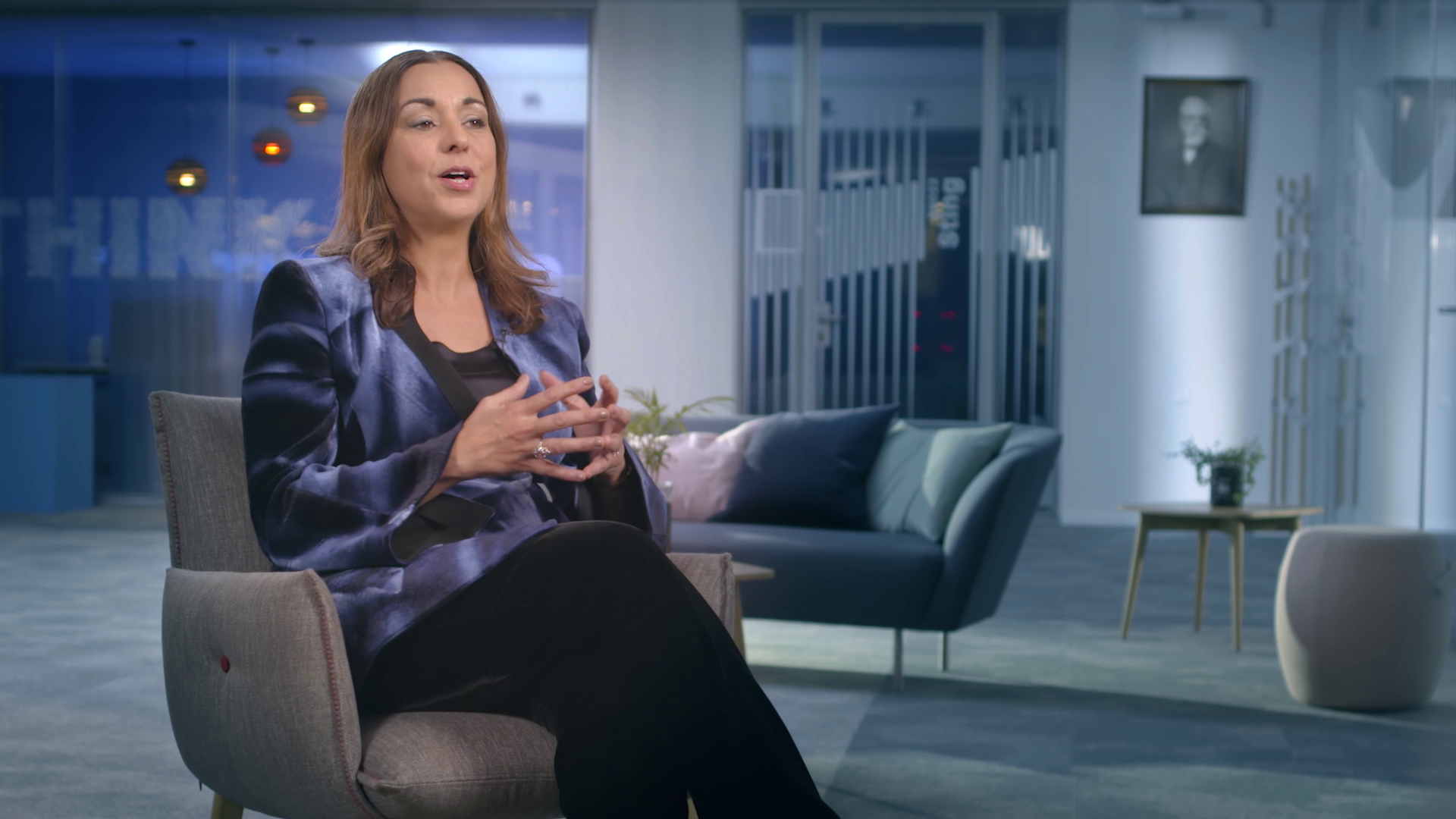
A successful filmed interview is not recognised by the quality of its lighting or the sharpness of its framing. It is recognised by one thing: we believe what the person is saying.
This is the hardest part of a corporate film. An executive reciting talking points, an employee watching their words, an expert speaking like a press release — the viewer senses it within seconds, and the message collapses along with the credibility.
At ORYGEN FILMS we have been shooting interviews for nearly ten years, for executive boards, communications departments and marketing teams. These are the seven principles that, in our experience, separate recited speech from speech that rings true.
Prepare the substance, never the script
This is the most common and most costly mistake: sending the questions in advance and letting the person write out their answers.
A learned text always shows. The eyes disengage, the delivery flattens, the sentences become too well built to be spontaneous.
So we share the themes, never the questionnaire. The person knows what they will be talking about; they do not know how the question will be put. They arrive prepared on substance and available on form.
Choose the person who knows, not the person who represents
Seniority is not a casting criterion.
On a technical subject, a workshop manager will often be more convincing than a director, because they are talking about what they do every day. On strategic vision, the opposite is true.
The question to ask before every interview is not “who should appear?” but “who genuinely owns what we want the audience to hear?”.
Give as much care to the location as to the frame
The setting is not a backdrop, it is information. A workshop, a laboratory, a construction site or an office tells the story of the work before the first word is spoken.
The location also acts on the person being interviewed. Someone filmed in their working environment is at home; the same person sitting against a neutral wall in an empty meeting room holds themselves differently.
So we favour lived-in locations, with depth behind the subject, and we happily accept a little real disorder over a perfect, mute set.
Ask open questions, one at a time
A closed question produces a closed answer. “Are you happy with the project?” yields “yes, very”. Unusable in the edit.
“Tell me about the moment you realised it was going to work” opens a story, with a setting, a date, an emotion.
So we keep questions short, open and anchored in the concrete — and we avoid stacking them: two questions in the same breath and the person will only answer the second.
Let the silence do the work
This is probably the most effective technique and the least used.
When someone finishes an answer, resist the urge to move on. Two or three seconds of silence, and very often they start speaking again. What they add then is more personal, less prepared, more true.
The best lines in an interview rarely come first. They come afterwards.
Film far longer than you need
Thirty usable seconds in a film often require forty minutes of conversation.
The first few minutes almost always go to releasing tension. The person listens to themselves, corrects themselves, hunts for phrasing. Only then do they forget the camera and begin to speak for real.
Allowing generous time is not a production luxury: it is the condition for having natural material in the edit rather than a series of technically correct takes.
Edit for truth, not for performance
In the edit, the temptation is to keep only the flawless sentences. That is how you end up with a film that is smooth and cold.
A hesitation, a smile, a breath are markers of authenticity. Well placed, they make the point credible.
Our rule is simple: we cut what gets in the way of understanding, and we keep what shows a person in the act of thinking.
What this changes for a corporate film
These seven principles are not about comfort on set. They determine whether the film works.
Speech that rings true makes a message memorable, an employer brand credible, an expertise demonstrable. That holds for a corporate film, for event coverage, for a social media format and for a presentation video alike.
At ORYGEN FILMS we therefore give as much attention to how the conversation is conducted as to the light, the sound and the frame. Because technique can be recovered; false speech cannot.
The role of a production team is not to make people say what they ought to say. It is to create the conditions in which they finally say what they actually think — and to be filming at the right moment.